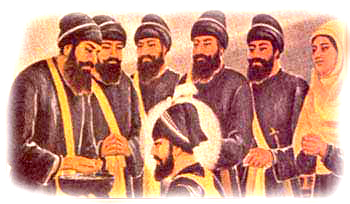
There upon, Bhai Dharam Dass came forward and offered his head. He was also taken to the tent and again Guru Ji came out with blood soaked sword and demanded yet another head. Then Bhai Mohkam Chand offered his head like his two predecessors. Likewise, Bhai Himat Rai and Bhai Sahib Chand offered themselves before the Guru. All of them were taken to the tent. Then all the five Sikhs were given new dress then Guru Gobind Rai prepared Amrit by stirring Iron Khanda in a Big iron Bowl (Baata) containing Water sweetened with Sugar balls and reciting Five Bani’s i.e. Japji Sahib, Jaap Sahib, Swayyey, Chowpai and Anand Sahib with continuous gaze ib tge stirring the Khanda and the Baata. Amrit was, thus, prepared. The five Sikhs in the tent then took the Amrit from Guru Ji. Their names also change. Now their new names were Bhai Daya Singh, Bhai Dharam Singh, Bhai Mohkam Singh, Bhai Himmat Singh and Bhai Sahib Singh.
After this the Guru reappeared before the gathering alongwith the five Sikhs neatly dressed in their new uniform. He called then his five Dear ones i.e. Panj Pyaras. They were Panj Pyaras not only of the Guru but of whole Sikh Panth. They were chosen one’s and superior beings. Thus, started the practice of Panj Pyaras being authorised to administor Amrit to the Sikhs and take collective decisions on behalf of Sikh Panth as they represent them. Then Guru Gobind Rai, himself sought Amrit from those Panj Pyaras and became Guru Gobind Singh.
The connenced the convention of "AAPE GUR CHELA". Guru Gobind Singh then explained Sikh code of conduct (Rehat Maryada) which was to be followed in variably by every sikh. He also explained significance of the creation of Khalsa - a cast less society where there were no rich, no poor - all being equal members of Khalsa Panth. They were saint soldiers - who would be eveready to sacrifice their lives in the struggle against political and social salvery and religious persecution. They would also come forward in support of victims of opperation. Thus, he infused a new spirit of self respect in the minds of Sikhs after this, whole Sikh Sangat was ordained to take Amrit from the Panj Pyaras and becom mambers of Khalsa brotherhood. They were also told that every Sikh’s name will be suffixed by Singh and Kaur for Men and Women respectively. It is said that about 60,000 sikhs readily took Amrit and became Khalsa - saint soldiers in a couple of days.
The creation of Khalsa by Guru Gobind Singh was not something new and different from the practice of preceeding Nine Gurus. In fact, this was logical climax of the efforts of Guru Nank and all the Gurus to mould men and women into perfect human beings both inspiritual and temporal domains. In the opinion of famous Historian Doctor Gokal Chand Narang, The steel for the sword prepared by Guru Gobind Singh Ji was forged by Guru Nanak.
BRIEF LIFE SKETCH OF PANJ PYARAS
1. Bhai Daya Singh Ji ( Daya Ram ) was born in Lahore ( now Pakistani Punjab ) in the year 1669 A.D.. He was Khatri by Caste. He offered his head to Guru Gobind Singh on the Baisakhi day 1699 A.D. . At the age of 30 th years. He remain in the presences of Guru Gobind Singh till he left his mortel body in nanded in the year 1708 A.D.
2. Bhai Dharam Singh Ji (Bhai Dharam Das) He was Jaat by caste and belonged to Hastenapur (Delhi). He was born in 1666 A.D.. He also passed away in Nanded in the presence of Guru Gobind Singh Ji.
3. Bhai Mohkam Singh Ji (Mohkam Chand ) He belonged to Dwarka In Surashtra reigion of Gujrat. He was born in 1663 A.D. in low caste family of chheemba (Washermen). He sacricficed his life in battle of Chamkaur Sahib in 1704 A.D.
4. Bhai Himmat Singh Ji (Himmat Rai) He was born in the year 1661 A.D. in a low caste Jhiwar (Water bearer) family. He belonged to Jagannath Puri In Orrisa. He also became a martyar in a battle of Chamkaur Sahib in 1704 A.D.
5. Bhai Sahib Singh Ji (Sahib Chand) He Was born in Bidar (Andhra) in 1662 A.D. in low caste Nai (Barber) family. He also sacrificed his life in the Battle of Chamkaur Sahib in 1704 A.D.
Thus it will be seen that the Panj Pyaras belonged to all religion of India and were from both High and Low caste. Thus they were representative of whole India. |